
BUTT DIAL vs BOOTY CALL
and the quandary of the expectation-outcome mismatch

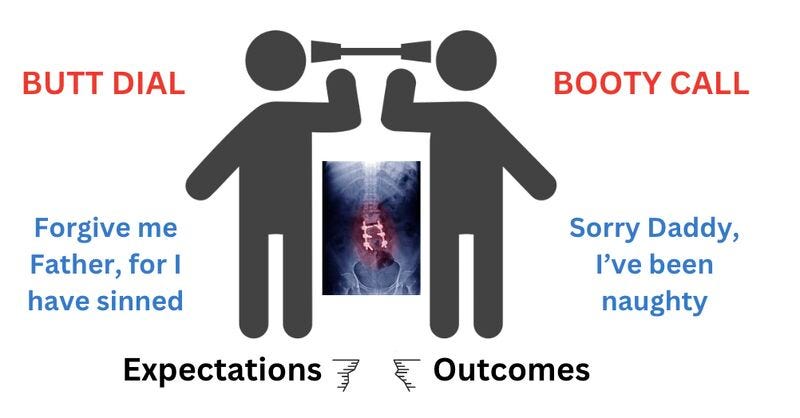
2 purely identical terms, but 2 incredibly different meanings…
COMMUNICATION is so important!
The posting of acute post-op spine X-rays on social media are fun to look at … but, we all know that they may not actually predict the patient’s outcome/satisfaction.
In today’s surgical environment, the success of our surgeries is measured not only by objective measures such as length of stay, neurologic outcomes and these Xrays, but also by more subjective patient measures including patient-reported outcomes and satisfaction with surgery. Although, we may show off beautiful post-op xrays — we know that there can by many patients out there that certainly are not as “satisfied” with their outcomes.
Why is that?!
Well, we know that patient outcomes are highly dependent on “transparent and clear communication.” What does that even mean? In spine surgery, we can struggle with this idea of the expectation-outcome mismatch — in which patient expectations exceeded the eventual actual outcome of surgery (aka, the outcome fell short of the expectations). As surgeons, we all know of many patients that have beautiful xrays, but are not nearly as satisfied with their outcome as the xrays demonstrate.
And there in lies the importance of COMMUNICATION. We think we are good at “communicating” at great length, but it is largely one-sided. We all love the sounds of our own voices. Surgeons present the risks of surgery, often with percentages or statements of “likely”, “unlikely” or “rare”, yet we are primarily referring to the absolute magnitude of the negative outcome without taking into account these issues of the PATIENT’s RISK tolerance, capacity and need. In certain circumstances (the elite athlete needing to return to play, for example), these categories are relatively apparent to both parties, yet in the majority of circumstances they are rarely, if ever, discussed. This gap may play into the “expectation-outcome mismatch” and thereby contribute to postoperative dissatisfaction with surgery.
If we are doing all the talking and thinking on behalf of the patient, we may be saying “Forgive me, Father; I have sinned” … but the patient is really just hearing… “Sorry, Daddy, I’ve been naughty”
Shared decision-making/communication is critical in setting realistic expectations of surgery. Yet as surgeons focused on minimizing negative outcomes or complications, our assessment of “expectations” may differ from those deemed valuable or relevant to the patient.
We need to do a better job of listening and learning. Or else, our beautiful post-op xrays are only that … one small tree in a large forest. And when you zoom out, it’s just one small tree still standing in a wildfire.
At the end of the day, if you are expecting a “booty call,” but the call is actually just a butt dial — that expectation-outcome mismatch will be MASSIVE. And we need to close that gap.